
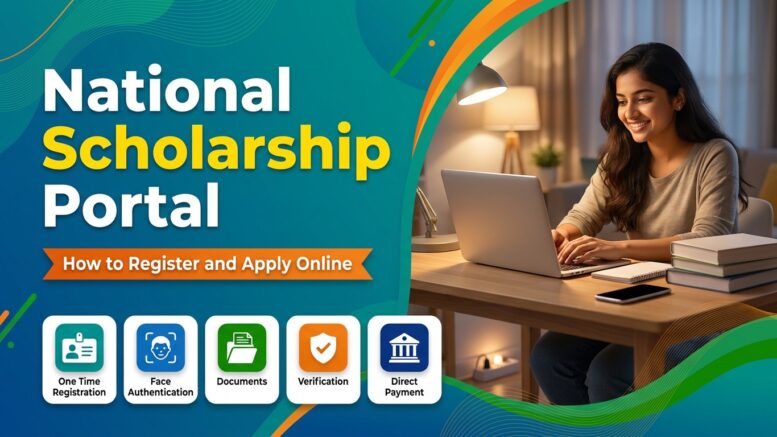
Looking for financial help with school or college fees? The National Scholarship Portal (NSP) is the single government website where Indian students can register once and apply for many central and state scholarships online.
Key takeaways
- OTR is a one-time, 14-digit registration valid for your entire academic career.
- Face authentication through UIDAI’s FaceRD app is mandatory to generate OTR.
- Applications are verified first by your institute and then by the district, state or ministry level.
- Scholarship money is paid by Direct Benefit Transfer, so keep an Aadhaar-seeded bank account ready.
What is the National Scholarship Portal?
The National Scholarship Portal (NSP) is a Government of India platform that brings scholarship schemes from central ministries, state governments and bodies such as UGC and AICTE onto one website. Students can apply, track and receive scholarships without visiting multiple offices. The portal is available at scholarships.gov.in.
One Time Registration (OTR) is a unique 14-digit number generated after Aadhaar-based e-KYC. According to the NSP OTR FAQ, it acts as your login ID and stays valid throughout your academic career, so you do not need to register again every year.
Who can apply?
Students from Class 1 to post-graduation and PhD can apply, depending on the scheme. Each scholarship has its own eligibility conditions, such as family income limit, minimum marks, category or course type. Check the scheme guidelines on NSP before applying. From academic year 2026-27, the NSP homepage notes that students may apply for one merit-based scheme and one or more welfare-based schemes.
School students preparing for board exams can also use our guide to online NCERT solutions for CBSE students to keep their marks within merit-scheme limits.
Types of scholarships available on NSP
NSP lists three broad groups of schemes, and you can filter them on the portal:
- Central schemes: run by Union ministries, such as the Central Sector Scheme of Scholarships for college and university students and PM YASASVI for OBC, EBC and DNT students.
- State schemes: run by state governments that have joined NSP, usually for students domiciled in that state.
- UGC and AICTE schemes: for students in higher and technical education, such as schemes for girls and for students with disabilities.
Pre-matric schemes cover school students up to Class 10, while post-matric schemes cover Class 11 onwards, including diploma, undergraduate and postgraduate courses. Engineering aspirants applying for entrance exams such as JEE Main 2027 can plan ahead for technical-education scholarships once admitted.
Documents you need
- Active mobile number
- Aadhaar number (or Aadhaar Enrolment ID; minors can use a parent’s or guardian’s Aadhaar; young children can get a Baal Aadhaar)
- Bank account seeded with Aadhaar for DBT
- Previous year marksheet and current admission or fee receipt
- Income certificate, caste certificate and domicile certificate, as required by the scheme
- Passport-size photograph
How to create your OTR: step by step
OTR is created partly on the website and partly on an Android smartphone, because face authentication runs through two mobile apps.

- Visit scholarships.gov.in and click “Apply for One Time Registration (OTR)”.
- Read the guidelines, verify your mobile number with OTP and enter your Aadhaar or EID details to receive a reference number.
- Install UIDAI‘s AadhaarFaceRD app and the NSP OTR app from the Google Play Store.
- Open the NSP OTR app, enter the reference number and complete eKYC with face authentication.
- Your 14-digit OTR number is generated and sent to your registered mobile.
How to apply for a scholarship after OTR
- Log in to NSP with your OTR number and password or OTP.
- Complete the profile: personal, academic and bank details.
- Open the application form and select the scheme(s) you are eligible for.
- Upload required documents in the stated format and size.
- Preview carefully and submit. Download or note the application ID.
- Ask your institute’s nodal officer to verify your application before the institute verification deadline.
How verification and payment work
| Stage | Who acts | What happens |
|---|---|---|
| Application | Student | Submits form and documents on NSP |
| Level 1 (L1) verification | Institute nodal officer | Checks enrolment, marks and documents |
| Level 2 (L2) verification | District, state or ministry officer | Second check based on scheme rules |
| Sanction and payment | Ministry / department | Amount credited through DBT to the Aadhaar-seeded account |
When is the NSP application window open?
The portal usually opens for a new academic year around mid-year and closes in phases towards the end of the calendar year. For example, NSP opened for academic year 2026-27 on 1 June 2026, with deadlines varying by scheme. Renewal and fresh applications often have different last dates, so check the announcements section regularly.
Practical tips
- Make sure your Aadhaar biometrics are unlocked before face authentication; error 904 is usually fixed by updating the FaceRD app, according to NSP.
- Check your bank account’s Aadhaar seeding status through NPCI’s BASE platform linked on NSP.
- Apply early; servers are busy close to deadlines.
- If you need help, Common Service Centres (CSC) offer assisted applications for INR 30, as of November 2026.
Common mistakes to avoid
- Name mismatch between Aadhaar, marksheet and bank account.
- Forgetting to follow up with the institute for L1 verification.
- Applying under a scheme where you do not meet the income or marks limit.
- Registering with EID and not updating Aadhaar details within a month, which can suspend OTR.
Related reads on TON
- UPTET 2026 registration: fees, eligibility and how to apply
- How to start NEET preparation after Class 10
- Top skills to learn in 2027 for career growth
Frequently Asked Questions
Is OTR mandatory to apply on the National Scholarship Portal?
Yes. All students must generate a One Time Registration number before applying for scholarships on NSP. It is free and valid for your entire academic career.
Can I apply on NSP without Aadhaar?
Yes, with conditions. You can use an Aadhaar Enrolment ID, or minors can use a parent’s or guardian’s Aadhaar, but Aadhaar details must be updated later as per NSP rules.
Do I need to create a new OTR every year?
No. OTR is generated once and works for all future applications and renewals during your studies.
How will I receive the scholarship amount?
Scholarships are credited through Direct Benefit Transfer to your bank account. Make sure the account is active and seeded with Aadhaar.
Is there a fee to apply on NSP?
No. Applying on NSP and generating OTR are free. Only optional assisted services at CSCs carry a small fee.
Never miss an education update. Bookmark Trending Online Now and follow us for more student guides.
By TON Editorial Team · Last updated November 2026. Check the National Scholarship Portal for the latest details.