
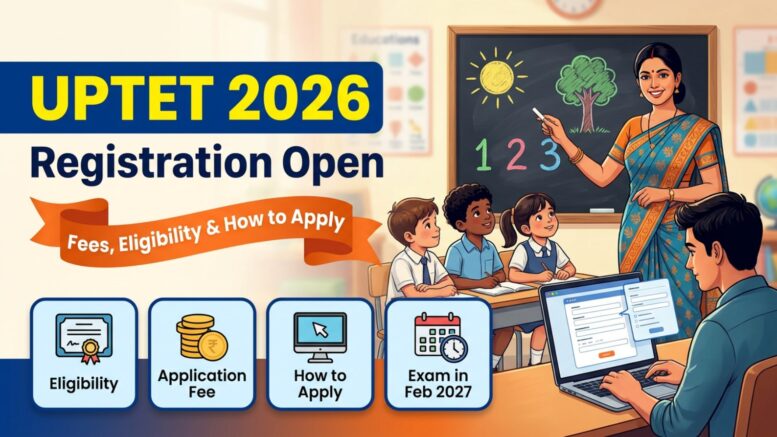
The application window for UPTET 2026 is now open. Anyone who wants to teach Classes 1 to 8 in Uttar Pradesh has until 23 December 2026 to pay the fee, and the exam is set for 26 and 27 February 2027.
What Has Been Announced
The Uttar Pradesh Education Service Selection Commission (UPESSC), based in Prayagraj, put out a short notice on 18 November 2026 about the next Uttar Pradesh Teacher Eligibility Test (UPTET). On 24 November it followed up with the detailed advertisement, numbered 10/2026, and opened online registration. The advertisement covers both levels of the test: the primary level (Paper 1) for teaching Classes 1 to 5, and the upper primary level (Paper 2) for teaching Classes 6 to 8.
UPTET is an eligibility test, not a recruitment exam. If you pass, you get a certificate that lets you apply for teaching posts in government and recognised schools in the state. The certificate does not guarantee a job. Several reports point out that you still have to compete separately for actual vacancies.
UPTET 2026: Key Dates at a Glance
Application Fee
The fee is charged per paper. If you want to sit both Paper 1 and Paper 2, you pay twice. Several reports agree on these amounts:
The fee can only be paid online. Some reports published before 24 November did not give the fee amounts, so check the figure against the official advertisement before you pay.
Who Can Apply
Eligibility depends on the paper. Here is a broad outline based on what education news outlets have reported:

- Paper 1 (Classes 1 to 5): usually a graduate degree with a two-year D.El.Ed or BTC diploma, or at least 50 per cent in Class 12 with a four-year B.El.Ed. Equivalent qualifications recognised by NCTE or RCI, such as special education diplomas, are also mentioned.
- Paper 2 (Classes 6 to 8): usually a graduate degree with a D.El.Ed/BTC or a B.Ed, or at least 50 per cent in Class 12 with a four-year integrated course such as B.El.Ed, B.A.-B.Ed or B.Sc.-B.Ed.
Candidates in the final year of these courses can generally apply. Reports differ on the exact minimum percentages, and the age limits for this cycle had not been clearly reported at the time of writing. Read the eligibility section of Advertisement No. 10/2026 on the UPESSC website before you fill in the form.
How to Apply for UPTET 2026
You must complete a One Time Registration (OTR) before you can open the UPTET application form. The process works like this:

- Go to the UPESSC website (upessc.up.gov.in). The OTR instructions are on uptet.upessc.org.
- Complete the One Time Registration with your basic details, mobile number and email ID.
- Log in with your OTR credentials and select Advertisement No. 10/2026.
- Enter your personal, educational and professional qualification details.
- Choose Paper 1, Paper 2 or both, depending on your eligibility.
- Upload your photograph, signature and supporting documents in the required format.
- Pay the fee online by 23 December 2026.
- Check everything, submit the form, and download the confirmation page.
Documents to Keep Ready
- Class 10 marksheet (used as proof of date of birth)
- Marksheets and certificates for Class 12, graduation and your teacher-training course
- Caste or disability certificate, if you are applying in a reserved category
- A government-issued photo ID
- A recent passport-size photograph and your signature, scanned to the required size
Exam Pattern in Brief
Earlier reports on UPTET describe each paper as having 150 multiple-choice questions on an OMR sheet. Both papers include Child Development and Pedagogy, Language I and Language II. Paper 1 also covers Mathematics and Environmental Studies. Paper 2 covers Mathematics and Science or Social Studies, depending on the subject stream you choose. Some details, such as timing and marking rules, vary between reports, so treat the official information bulletin as the final word.

Practical Tips for Applicants
- Do not wait until the last week. Government portals often slow down near deadlines, and a failed payment close to 23 December could cost you this cycle.
- Use only official websites. Fake sites that copied the UPTET registration page were reported in an earlier cycle. Apply only through the UPESSC domains.
- Check your name and date of birth carefully. These must match your Class 10 records exactly. The correction window closes on 27 December 2026.
- Decide on one paper or both early. Each paper has its own fee, so make sure you meet the eligibility conditions for each one you choose.
- Save your confirmation page and payment receipt in case you need them later for admit card or result queries.
- Start preparing now. The exam is about three months away. Child Development and Pedagogy is common to both papers, so it is a good place to begin.
Frequently Asked Questions
What is the last date to apply for UPTET 2026?
The application fee must be paid by 23 December 2026, and corrections are allowed until 27 December 2026. Treat 23 December as your effective deadline for submitting the form.
Does passing UPTET give me a government teaching job?
No. UPTET only certifies that you are eligible to teach Classes 1 to 8 in Uttar Pradesh. You still have to apply and compete separately when recruitment for teaching posts is announced.
Can I appear for both Paper 1 and Paper 2?
Yes, if you meet the eligibility conditions for both levels. You choose the papers during the application and pay the fee separately for each one.
Information as of 25 November 2026. Check Uttar Pradesh Education Service Selection Commission (UPESSC) for the latest updates.
Image credits: “A Classroom in a Government Primary school in Kerala” by Ramjchandran, Wikimedia Commons, CC BY-SA 4.0