
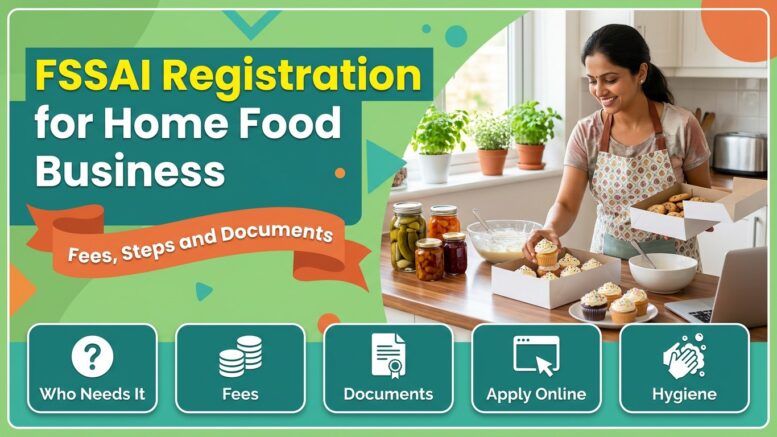
Selling cakes, tiffins or pickles from your kitchen? FSSAI registration for home food business is a legal requirement in India, and for most home cooks it is a simple online process that costs just INR 100 a year.
Key takeaways
- Every food business, including home bakers, tiffin services and cloud kitchens, needs FSSAI registration or a licence.
- FSSAI’s revised table (updated 1 April 2026) raised the Basic Registration limit to INR 1.5 crore turnover.
- Basic Registration costs INR 100 per year and can be taken for 1 to 5 years.
- Applications are filed online on FoSCoS; your home address is acceptable as premises proof.
What is FSSAI registration?
FSSAI registration is the permission every food business operator (FBO) must hold under the Food Safety and Standards Act, 2006. The Food Safety and Standards Authority of India (FSSAI) issues three levels of permission depending on the size and type of business: Basic Registration, State Licence and Central Licence. The registration number must be printed on your packaging, menus or online listings.
Who needs FSSAI registration for home food business?
Yes. Anyone who prepares and sells food, even from a home kitchen, counts as a food business operator. This covers home bakers, tiffin and meal-box services, pickle and snack makers, and people selling through Instagram, WhatsApp or food delivery apps. Delivery platforms such as Swiggy and Zomato also ask for a valid FSSAI number before listing a kitchen.

Very small operators such as petty retailers, hawkers and temporary stall holders also fall under Basic Registration rather than being exempt. If you are unsure which category fits, the eligibility tool on FoSCoS suggests the right form once you choose your kind of business and turnover.
Which FSSAI registration type do you need?
The type depends mainly on your annual turnover. According to FSSAI’s eligibility document on FoSCoS, updated on 1 April 2026, the thresholds and annual fees are:
| Type | Annual turnover (as of April 2026) | Fee per year | Typical home business fit |
|---|---|---|---|
| Basic Registration | Up to INR 1.5 crore | INR 100 | Home bakers, tiffin services, small snack makers |
| State Licence | Above INR 1.5 crore up to INR 50 crore | INR 5,000 (most categories) | Growing brands with a production unit |
| Central Licence | Above INR 50 crore, or importers, exporters and e-commerce operators | INR 7,500 | Large manufacturers and platforms |
Older guides still quote limits of INR 12 lakh and INR 20 crore. Those figures were replaced by the April 2026 revision, so always check the current table on FoSCoS before applying.
Documents needed for FSSAI Basic Registration
Basic Registration needs very few documents. Keep these ready as clear scans:
- Recent passport-size photograph of the applicant
- Identity proof such as Aadhaar, PAN, voter ID or passport
- Proof of premises: for a home business, your home address proof (rent agreement, electricity bill or property document) is sufficient
- List of food products you plan to make and sell (our look at food trends Indians are following can help you plan a menu)
- Form A (the application form, filled online on FoSCoS)
How to apply for FSSAI registration online: step by step
- Visit FoSCoS: open the FSSAI FoSCoS portal and sign up with your mobile number and email.
- Check eligibility: use the eligibility tool, choose your state and kind of business (for example, “Restaurant/Home-based catering” or “Manufacturer”) and enter expected turnover.
- Fill Form A: enter your name, address, food categories and the number of years you want (1 to 5).
- Upload documents and the photograph.
- Pay the fee online. For 5 years of Basic Registration, that is INR 500.
- Track the application: the local food safety officer may inspect the premises or ask for clarifications.
- Download the certificate with your 14-digit registration number once approved.
Hygiene basics every home kitchen should follow
Registration also means you agree to follow FSSAI’s basic hygiene and safety requirements. In practice, that means:

- Use safe, potable water for cooking and cleaning.
- Store raw and cooked food separately, and refrigerate perishables.
- Keep the kitchen free from pests and clean surfaces after every batch.
- Label packed food with the product name, ingredients, date of manufacture, best-before date and FSSAI number.
- Wear clean clothes, cover hair and avoid cooking when unwell.
Common mistakes to avoid
- Starting sales before registering: operating without FSSAI registration can attract penalties under the FSS Act.
- Choosing the wrong business category: this delays approval or leads to rejection.
- Missing renewal: FSSAI charges a late fee of INR 100 per day if you renew after expiry, according to Tally Solutions’ FSSAI fee guide.
- Using old turnover limits: rely on the latest FoSCoS table, not old blogs.
- Not displaying the number: print the 14-digit number on labels and online menus.
Related reads on TON
- Ways to make healthy food more interesting for kids
- How IRCTC used live streaming to build trust in kitchen hygiene
- Top skills to learn in 2027 for career growth
Frequently Asked Questions
How much does FSSAI registration cost for a home business?
FSSAI Basic Registration costs INR 100 per year as of April 2026. You can pay for up to 5 years at once, which costs INR 500.
Can I get FSSAI registration on my home address?
Yes. Home-based food businesses can register using their residential address as premises proof. You do not need a separate commercial kitchen for Basic Registration.
How long is FSSAI registration valid?
You can choose validity from 1 to 5 years while applying. Renew it before expiry on FoSCoS to avoid a late fee.
Is FSSAI registration needed to sell on Instagram or WhatsApp?
Yes. Selling food through social media still makes you a food business operator. Customers and platforms increasingly ask for the FSSAI number before ordering.
What is the FSSAI registration number format?
FSSAI registration and licence numbers have 14 digits. The number identifies your registration and must appear on your food labels.
Running a small food business? Bookmark Trending Online Now and follow us for more step-by-step guides.
By TON Editorial Team · Last updated November 2026. Check the FSSAI FoSCoS portal for the latest details.