
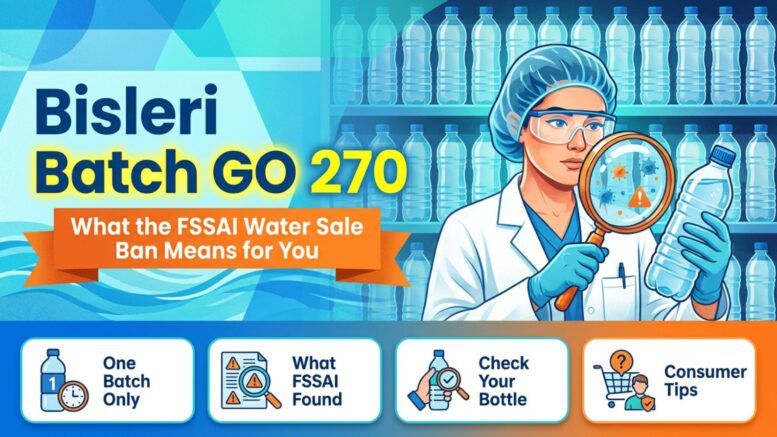
Worried about the packaged drinking water in your fridge after this week’s FSSAI headlines? Here is what the food regulator actually did, what Bisleri says, and how you can check the bottle in your hand.
What happened
On Sunday, 22 November 2026, the Food Safety and Standards Authority of India (FSSAI) announced through social media posts that it had sanctioned prosecution against Bisleri International under the Food Safety and Standards Act, 2006. According to reports in Business Standard and India TV, the action relates to one regulatory sample of packaged drinking water (in the category other than mineral water) collected from the company’s premises.

As reported, that sample first failed the prescribed limit for bromate. The company appealed, and the sample was then examined by a Referral Food Laboratory, which also declared it unsafe, this time citing polynuclear aromatic hydrocarbons (PAHs). FSSAI noted that several PAHs can be toxic when they cross safe limits.
It is important to understand that a sanction for prosecution allows legal proceedings to begin. It is not a court verdict, and no court has ruled on the matter so far.
FSSAI’s clarification on 23 November
A day later, on Monday, 23 November, FSSAI issued a clarification, according to PTI reports carried by ThePrint and The Week. The regulator said:
- The prohibition-of-sale order covers only one batch, numbered GO 270.
- Only that batch was found non-compliant, and Bisleri has been asked to carry out a root cause analysis.
- On re-testing of the batch sample, bromate was below the permissible limit.
- Under the law, if a food business appeals, the referral laboratory’s report is treated as final.
What Bisleri says
In a statement on Tuesday, 24 November, Bisleri said the scrutiny is limited to that single batch, which it says was produced at its Goa plant on 27 September 2025 and is no longer available in the market. Key points from the company’s statement, as reported by PTI:
- In a later round of testing on six samples, one showed PAHs at 0.144 micrograms per litre, while another sample from the same batch cleared all parameters.
- The company says it questioned discrepancies in the findings and asked for a retest of the PAH results in February 2026.
- It says all 143 of its manufacturing plants remain operational and compliant, and that the Goa plant has not received any suspension order.
- It says it makes more than 50,000 batches a year, and that later samples from its plants, including later Goa production, met applicable standards.
- It says it had not received a formal notice of the reported action and that it will cooperate with the regulator while defending its position.
Reports note that some of these points come from the company’s own account. The two sides differ on how the PAH result should be read, so readers should follow the regulator’s official updates for the final position.
Key facts at a glance
| Item | Details (as reported) |
|---|---|
| FSSAI announcement | 22 November 2026 (Sunday) |
| FSSAI clarification | 23 November 2026 (Monday) |
| Bisleri statement | 24 November 2026 (Tuesday) |
| Batch under sale prohibition | GO 270 |
| Plant and manufacture date | Goa, 27 September 2025 (per Bisleri) |
| Issues flagged | Bromate in first test; PAHs at referral lab |
| Bromate on re-test | Below permissible limit (per FSSAI clarification) |
| Stock in market | None, according to Bisleri |
Other companies named in the same FSSAI update
Bisleri was not the only name in the regulator’s 22 November update. As reported by Business Standard, FSSAI also sanctioned prosecution against Vasant Masala and Tit-Bit Foods over chilli powder with pesticide residues above limits, and against Mimansa Industries over walnut kernels with quality problems. Asha Confectionery was ordered to recall pre-packaged chocolate-filled cookies found unsafe. Licences of Urmi Lifesciences and Gaur Ayurvedic Store were suspended. The report adds that FSSAI has stepped up enforcement against food businesses and e-commerce firms this year.
Practical tips for consumers

- Read the batch number: Every packaged water bottle carries a batch or lot number and a manufacturing date, usually near the cap or on the label. The sale prohibition applies only to batch GO 270.
- Check the date: The batch in question was made in September 2025. If you have very old stock lying at home, it is sensible to check the label before use.
- Look for licence details: Packaged food and water labels should show an FSSAI licence number. Avoid unlabelled or damaged bottles, and buy from trusted shops.
- Store bottles well: Keep bottled water away from direct sunlight and heat, and do not reuse single-use bottles for long periods.
- Report a concern: If you suspect any food or water product is unsafe, you can raise a complaint through FSSAI’s Food Safety Connect app or its online grievance portal.
- Avoid forwarding rumours: Check the batch number and official statements before sharing messages about any brand on social media.
Frequently Asked Questions
Is all Bisleri packaged drinking water banned?
No. As per FSSAI’s clarification on 23 November 2026, the prohibition-of-sale order applies only to batch GO 270. Bisleri says its plants remain operational and that no stock of that batch is in the market.
What are bromate and PAHs?
Bromate is a compound that can form when water containing bromide is disinfected with ozone, and food rules set a maximum limit for it. Polynuclear aromatic hydrocarbons are a group of chemicals, and FSSAI has said several of them can be toxic beyond safe limits.
Does prosecution mean Bisleri has been found guilty?
No. A sanction for prosecution only permits legal proceedings to start. Any final finding will come from the court process, and the company has said it will defend its position.
Information as of 25 November 2026. Check FSSAI official website for the latest updates.
Image credits: “Bisleri PET water bottles with Telugu labels” by Veeven, Wikimedia Commons, CC BY-SA 4.0