
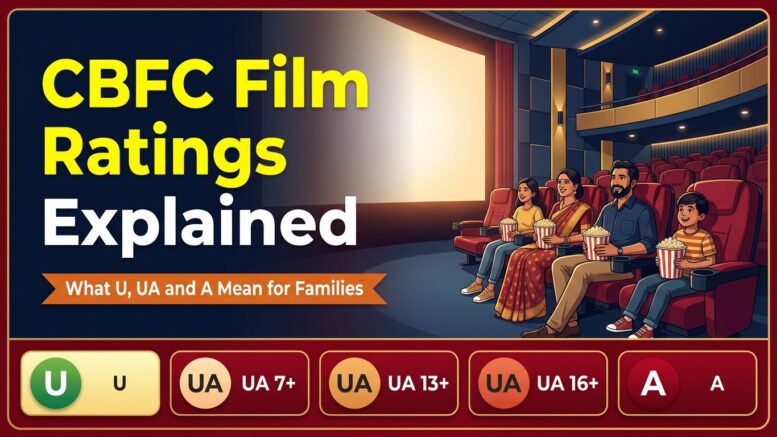
Every film released in Indian cinemas carries a CBFC certificate, but the newer age labels such as UA 7+, UA 13+ and UA 16+ still confuse many families. This guide explains what each CBFC film rating means, how parents should read it, and how it differs from the age ratings you see on OTT platforms.
Key takeaways
- The Central Board of Film Certification (CBFC) certifies films for public exhibition under the Cinematograph Act, 1952.
- The single UA category is now split into UA 7+, UA 13+ and UA 16+, which act as parental guidance markers.
- Only the A and S ratings legally restrict who can watch a film in a cinema.
- A CBFC certificate now remains valid permanently, following the 2023 amendment to the Cinematograph Act.
- Streaming platforms use their own similar age labels under the IT Rules, 2021, not CBFC certificates.
What is the CBFC?
The Central Board of Film Certification is the statutory body under the Ministry of Information and Broadcasting that certifies films before they can be shown in theatres. According to the CBFC’s official FAQ, its ratings are U, UA (UA 7+, UA 13+ and UA 16+), A and S. Video and DVD versions of films also need certification.

What do the CBFC film ratings mean?
Each rating tells you who the film is meant for and whether entry is restricted. The table below summarises them.
| Rating | Meaning | Is entry restricted? | What it means for families |
|---|---|---|---|
| U | Unrestricted public exhibition | No | Suitable for family viewing, including children |
| UA 7+ | Unrestricted, with parental guidance below age 7 | No | Parents decide for children under 7 |
| UA 13+ | Unrestricted, with parental guidance below age 13 | No | Parents decide for children under 13 |
| UA 16+ | Unrestricted, with parental guidance below age 16 | No | Parents decide for teens under 16 |
| A | Restricted to adults | Yes, 18+ only | Not for children or teenagers |
| S | Restricted to a specific profession or class of people | Yes | Meant for audiences such as doctors or scientists |
How should parents read UA 7+, UA 13+ and UA 16+?
A UA rating is advice, not a ban. The CBFC FAQ says the UA endorsement asks parents or guardians to consider whether a child below the stated age should watch the film. A 10-year-old can legally enter a UA 13+ film, but the label signals that the themes, language or violence may be better suited to viewers aged 13 and above.

A practical way to use the labels:
- UA 7+: mild content; most school-age children can watch, ideally with an adult for younger ones.
- UA 13+: stronger themes or action; check reviews or the trailer before taking a pre-teen.
- UA 16+: mature themes close to adult content; watch with your teen or decide case by case.
When did the new age-based categories start?
The Cinematograph (Amendment) Act, 2023 introduced the age-based UA sub-categories and made CBFC certificates valid permanently instead of for 10 years. The Cinematograph (Certification) Rules, 2024 then set out the process for these categories. Most recently, the Ministry of Information and Broadcasting notified revised certification guidelines on 16 September 2026, replacing the guidelines of 1991, as reported by Business Standard. Under the revised guidelines, films are judged as a whole, and U-rated films must be suitable for the entire family to watch together.
Are OTT shows and films rated by CBFC?
No. Content made directly for streaming platforms is not certified by CBFC. Under the Information Technology (Intermediary Guidelines and Digital Media Ethics Code) Rules, 2021, OTT platforms classify their own content into U, U/A 7+, U/A 13+, U/A 16+ and A, and must offer parental locks for content rated U/A 13+ and above. A film that releases in cinemas first and then streams usually keeps its CBFC certificate details, but the platform may also show its own age label.
Practical tips for choosing what your family watches
- Check the certificate shown at the start of the film or on the ticket booking page before you book.
- Read the content descriptors on OTT apps (for example, violence, language or substance use) along with the age label.
- Turn on profile PINs and kids’ profiles on every streaming app you use.
- Watch the trailer first if you are unsure about a UA 13+ or UA 16+ film.
- Talk to older children about why a film is rated as it is; it builds media awareness.
Common mistakes to avoid
- Assuming UA means “kids’ film”. It only means the film is not restricted.
- Treating UA 16+ like U; it is the closest category to adult content.
- Expecting a CBFC rating on web series; look for the platform’s own label instead.
- Ignoring an A rating because a film is popular; cinemas may refuse entry to under-18s.
Related reads on TON
Frequently Asked Questions
Can a child watch a UA 16+ film in a cinema?
Legally, yes. UA ratings do not restrict entry; they ask parents to decide whether a child below the stated age should watch. Only A and S films restrict entry.
What is the difference between U and UA 7+?
A U film is suitable for the entire family, including very young children. UA 7+ means parents should consider whether children under 7 should watch it.
What does the S certificate mean?
An S certificate limits screening to members of a particular profession or class of people, such as doctors. It is rarely used for mainstream releases.
How long is a CBFC certificate valid?
Since the Cinematograph (Amendment) Act, 2023, a CBFC certificate remains valid permanently. Earlier, certificates were valid for 10 years.
Who rates web series in India?
Web series and OTT originals are rated by the streaming platforms themselves under the IT Rules, 2021, using labels similar to CBFC’s.
Bookmark Trending Online Now and follow us for more simple explainers on movies, OTT and entertainment.
By TON Editorial Team · Last updated November 2026. Check the CBFC official website for the latest details.