
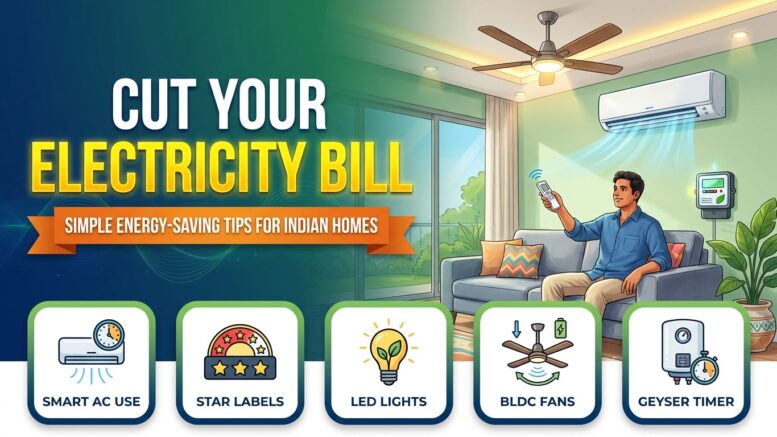
Air conditioners, geysers and old appliances quietly push up the monthly electricity bill in most Indian homes. This practical guide shows you how to reduce your electricity bill at home with simple habits, smarter appliance choices and a few low-cost upgrades that also make your home more sustainable.
Key takeaways
- Cooling and heating appliances usually make up the largest share of a home’s power use.
- Since 1 January 2020, star-labelled room ACs must come with a default setting of 24°C.
- The BEE star label shows yearly consumption in units (kWh), which helps you compare models.
- A 5-star AC can save about INR 1,200-1,800 a year over a 3-star model, depending on use.
- Small habits such as switching off at the plug and regular servicing add up over a year.
How is your electricity bill calculated?
Your bill is based on the units of electricity you use. One unit equals one kilowatt-hour (kWh), which is the energy a 1,000-watt appliance uses in one hour. Most state electricity boards use slab-based tariffs, so the rate per unit goes up as your monthly use rises. Cutting even 50-100 units a month can move you into a cheaper slab, so read the units section of your bill before trying to save.
Which appliances use the most electricity?
In most Indian homes, the biggest users are those that heat or cool. The table below gives typical power ratings to help you find where to focus.
| Appliance | Typical power use | Best way to save |
|---|---|---|
| Split AC (1.5 tonne) | About 1,200-1,800 W while the compressor runs | Set 24-26°C, clean filters, choose an inverter 5-star model |
| Electric geyser | 2,000-3,000 W | Use a timer, set 45-50°C, insulate pipes |
| Refrigerator | Runs 24 hours, so total use is high | Keep away from walls and heat, check door seals |
| Ceiling fan (conventional) | About 70-75 W | Switch to a star-rated BLDC fan |
| Incandescent or CFL bulb | 15-60 W | Replace with LEDs |
How do you use the AC without a huge bill?
Set the AC at 24°C or higher and keep the room sealed. According to the Ministry of Power, a Bureau of Energy Efficiency (BEE) notification made a 24°C default temperature mandatory for all star-labelled room ACs from 1 January 2020. Each degree lower makes the compressor work harder for longer.

- Use a ceiling fan with the AC so you feel cool at a higher temperature setting.
- Clean the filters every two weeks in summer and get the AC serviced before the season starts.
- Close curtains on sun-facing windows and heat-exposed rooms during the afternoon.
- Use the sleep or timer mode at night.
How to read the BEE star label
The BEE star label tells you how efficient an appliance is and how many units it is expected to use in a year. More stars mean lower consumption.
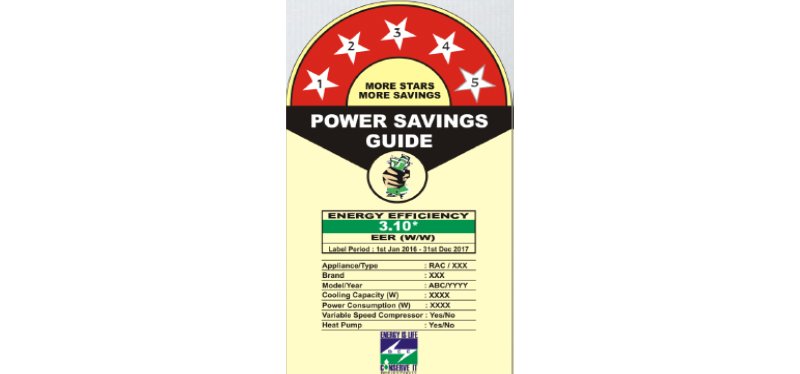
For ACs, the rating is based on the Indian Seasonal Energy Efficiency Ratio (ISEER), which accounts for Indian temperatures across a cooling season. According to a Down To Earth analysis, a 5-star AC uses roughly 740 kWh a year against about 1,008 kWh for a 3-star model, a saving of around INR 1,200-1,800 a year. Also check the label’s validity year, because BEE tightens the star bands periodically.
Step-by-step plan to reduce your electricity bill
- Check your last 12 bills to see your monthly units and seasonal peaks.
- List your appliances with their wattage and daily hours of use.
- Fix quick wins: LEDs, AC at 24°C, geyser timer, switching off at the plug.
- Plan upgrades: replace the oldest AC, fridge or fans with BEE 5-star or BLDC models.
- Consider rooftop solar if you own your roof and have high daytime use; check your state DISCOM’s net-metering process.
- Track units monthly and compare with the same month last year.
Practical everyday tips
- Switch appliances off at the plug; set-top boxes, chargers and microwaves draw standby power.
- Run washing machines and dishwashers with full loads, and use cold-water cycles where possible.
- Let hot food cool before putting it in the fridge, and do not overfill it.
- Use natural light in the day and light-coloured paint to brighten rooms.
- Iron clothes in one batch instead of a few pieces every day.
Common mistakes to avoid
- Setting the AC to 18°C to “cool faster”; it does not cool faster, it just runs longer.
- Buying a cheaper 3-star appliance without comparing yearly units on the label.
- Leaving the geyser on all day.
- Ignoring a faulty fridge door seal, which makes the compressor run constantly.
- Using an oversized AC for a small room, or an undersized one for a large room.
Related reads on TON
Frequently Asked Questions
Does switching off the AC at the wall save power?
Yes, a little. Many appliances, including ACs, draw standby power when switched off by remote, so turning them off at the plug avoids this waste.
Is a 5-star AC worth the higher price?
If you use the AC for many hours a day, usually yes. The extra cost is often recovered in about 4-6 years through lower bills, depending on your usage and tariff.
Do inverter ACs save electricity?
Inverter ACs adjust compressor speed instead of switching on and off, which generally saves power in long daily use. Compare the yearly units on the BEE label to be sure.
How much can LED bulbs save?
LED bulbs use far less power than incandescent bulbs for the same brightness and last much longer, so replacing all old bulbs is one of the cheapest ways to save.
What is a BLDC fan?
A BLDC (brushless DC) fan uses an efficient motor that typically draws less than half the power of a conventional ceiling fan at the same speed.
Bookmark Trending Online Now and follow us for more practical guides on saving money and living sustainably.
By TON Editorial Team · Last updated November 2026. Check the Bureau of Energy Efficiency for the latest details.