
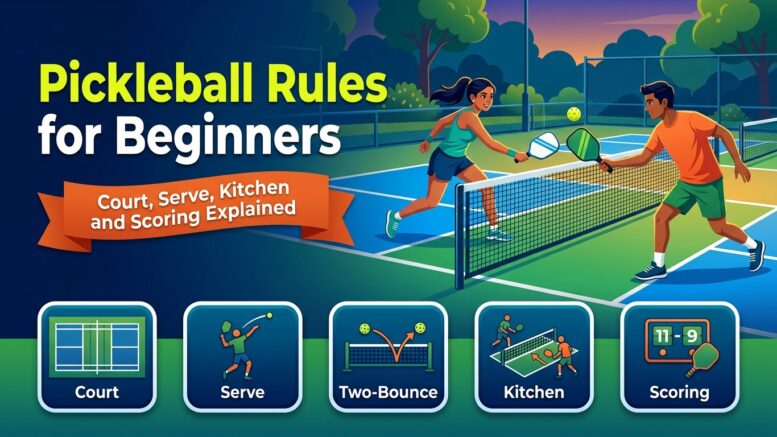
Pickleball is one of the easiest racquet sports to learn, and India’s clubs, apartment complexes and sports centres are adding courts every month. This guide to pickleball rules for beginners explains the court, the serve, the “kitchen” and scoring in plain English, so you can walk on to a court and play your first game with confidence.
Key takeaways
- The serve is underhand, hit below the waist, and must land diagonally beyond the kitchen line.
- The two-bounce rule means the return of serve and the next shot must both bounce before being hit.
- You cannot volley while standing in the 7 ft non-volley zone, or while touching its line.
- In doubles, the score is called as three numbers: serving team, receiving team, server number.
- Games are normally played to 11 points, and you must win by 2.
What is pickleball?
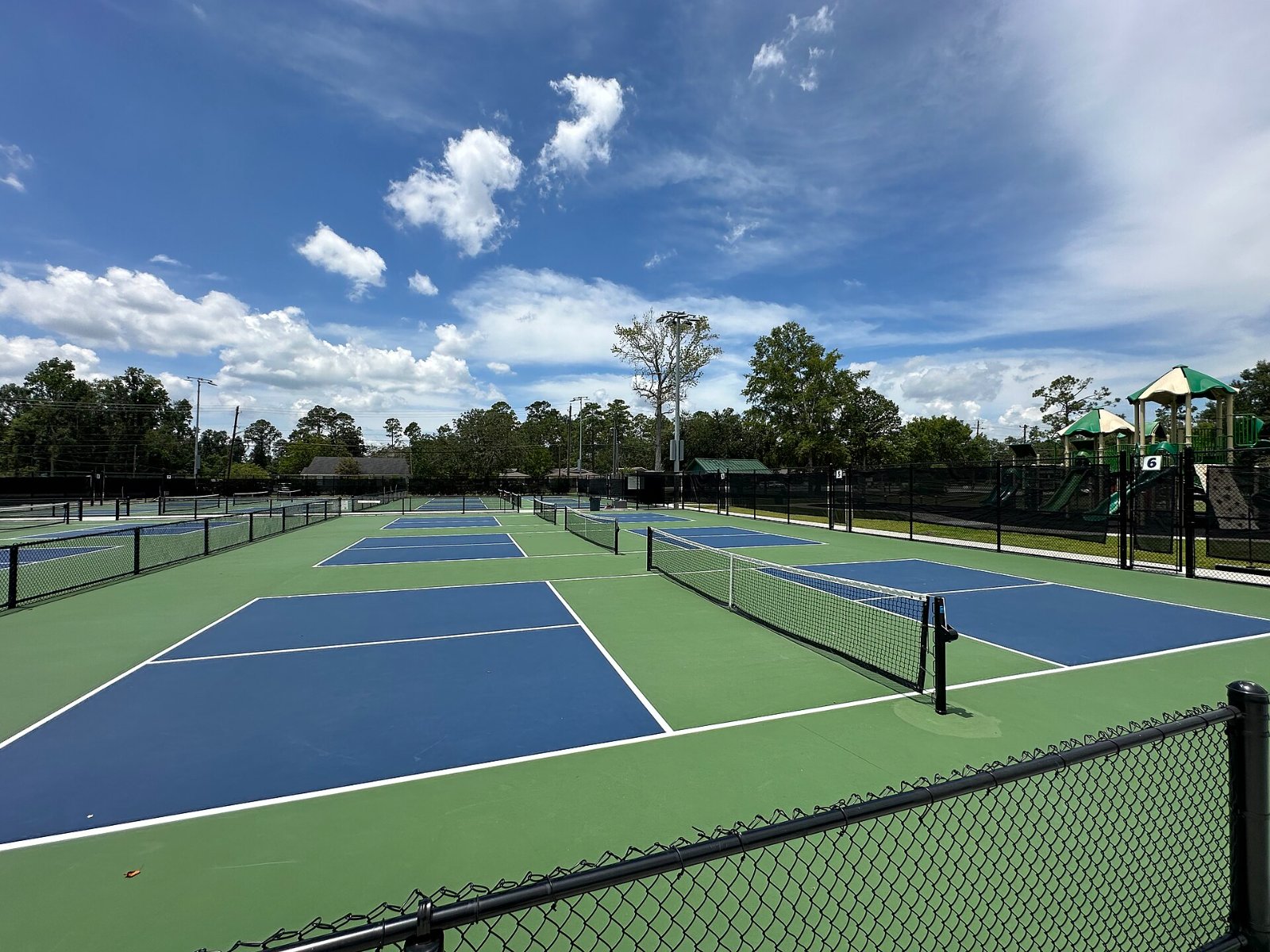
Pickleball is a paddle sport that mixes elements of tennis, badminton and table tennis. Players use a solid paddle and a light plastic ball with holes, on a court the size of a doubles badminton court. According to Tennis Australia, the court measures 6.1 m x 13.4 m, which is the same 20 ft x 44 ft footprint used under the official USA Pickleball rulebook. The net is 36 inches high at the sidelines and 34 inches at the centre.
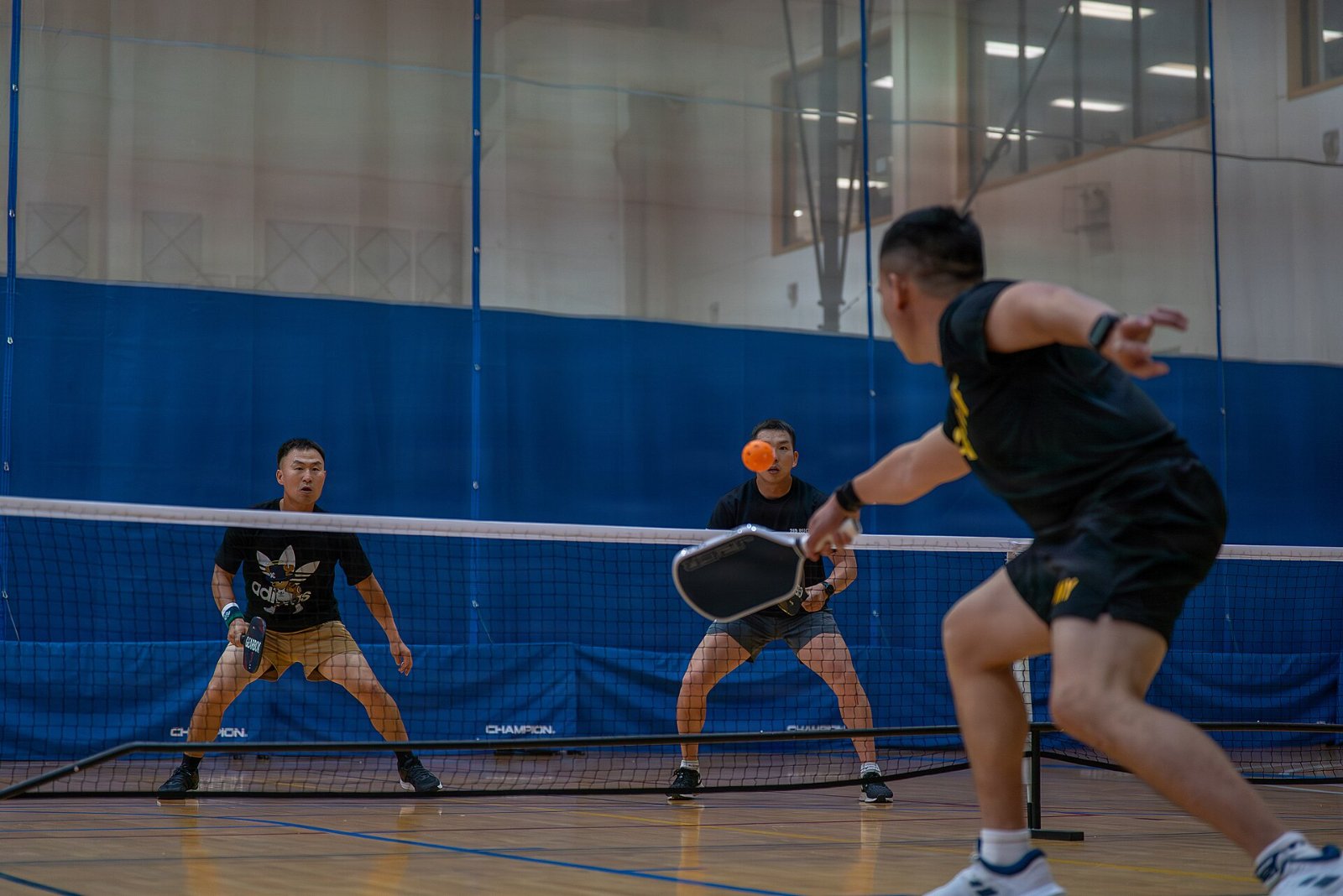
Because rallies are slower than tennis and the court is small, beginners usually rally within their first session. That is a big reason the sport has become popular with families, office groups and older adults in Indian cities.
Pickleball rules for beginners: key terms to know
- Non-volley zone (kitchen): the 7 ft area on each side of the net, from sideline to sideline.
- Volley: hitting the ball in the air before it bounces.
- Dink: a soft shot that drops into the opponent’s kitchen.
- Side out: when the serving side loses the serve and it passes to the opponents.
- Fault: any rule break that ends the rally.
How do you serve in pickleball?
You serve underhand and diagonally, from behind the baseline, into the opposite service court beyond the kitchen line. Under the USA Pickleball rules summary (revised January 2025), the serve has these requirements:
- Your arm must move in an upward arc when the paddle hits the ball.
- Contact must be below waist level, and the paddle head must not be above the highest part of your wrist.
- At least one foot must be behind the baseline, and neither foot may touch the court or go outside the imaginary extension of the sideline or centre line.
- You get only one attempt per serve. There is no second serve as in tennis.
- A serve that lands in the kitchen or on the kitchen line is “short” and is a fault.
The drop serve is also allowed. You simply drop the ball (no toss or throw) and hit it after it bounces. With a drop serve, the upward-arc and below-waist requirements do not apply, which makes it a good option for beginners.
What is the two-bounce rule?
The two-bounce rule says the ball must bounce once on each side before anyone can volley. The receiving team must let the serve bounce before returning it, and the serving team must then let the return bounce before hitting it. After those two bounces, players may volley or play off the bounce.
This rule stops the serving side from rushing the net and smashing the return, so rallies last longer and the game stays fair for beginners.
What are the kitchen (non-volley zone) rules?
You may not volley while standing in the kitchen or touching its line. If your momentum after a volley carries you into the kitchen, even after the ball is dead, it is still a fault. However, you can step into the kitchen at any time to play a ball that has already bounced. Most beginner faults come from forgetting this rule, so practise stopping behind the line before volleying.
How does pickleball scoring work?
In traditional pickleball scoring, only the serving side can win a point. Games are played to 11 points and must be won by 2. Tournaments may play to 15 or 21, also win by 2.
| Format | How the score is called | Who serves and when |
|---|---|---|
| Doubles | Three numbers: serving team score, receiving team score, server number (1 or 2), e.g. “5-3-1” | Both partners serve before a side out, except at the start of the game when only one partner serves. The server switches sides after each point won. |
| Singles | Two numbers: server’s score, then receiver’s score | Serve from the right court when your score is even and from the left when it is odd. One fault means a side out. |
| Rally scoring (optional) | A point is scored on every rally, by either side | Used in some leagues and events to make match times predictable. |
The game always starts at “0-0-2” in doubles, because the first serving team gets only one server before the first side out.
What counts as a fault?
A fault ends the rally. According to USA Pickleball, the common faults are:
- The serve does not land in the correct service court, or touches the kitchen line.
- The ball goes into the net or lands out of bounds.
- A player volleys before the ball has bounced once on each side.
- A player volleys from inside the kitchen, or momentum carries them into it.
- The ball bounces twice before being returned.
- A player, their clothing or their paddle touches the net or net post during a rally.
- The ball hits a player or anything they are wearing or carrying.
Line calls are simple: a ball touching any line is in, except a serve that touches the kitchen line. In casual play, each side calls the lines on its own half of the court.
Practical tips for your first game
- Start with the drop serve until your underhand stroke is consistent.
- After you return serve, move forward to the kitchen line; it is the strongest position in doubles.
- Use soft dinks to slow the rally down instead of hitting everything hard.
- Call the full score out loud before every serve, which avoids confusion.
- Wear non-marking court shoes with good lateral support, not running shoes.
- Warm up for 5-10 minutes, and check with a doctor before starting if you have joint, heart or other health conditions.
Common mistakes to avoid
- Volleying the return of serve, which breaks the two-bounce rule.
- Stepping on the kitchen line while hitting a volley.
- Hitting the serve above the waist or with a sidearm, tennis-style motion.
- Forgetting the server number in doubles and serving from the wrong side.
- Standing on the baseline after serving and never moving forward.
Related reads on TON
- How the Fit India Movement is encouraging everyday fitness
- Fitness gadgets and apps that help you track your workouts
- Digital detox: practical ways to cut your screen time
Frequently Asked Questions
Is pickleball easier than tennis or badminton?
For most beginners, yes. The court is small, the ball is slow and the serve is underhand, so new players can rally quickly. Advanced play still needs real skill, tactics and fitness.
Can you hit the ball in the kitchen?
Yes, but only after it has bounced. You can stand in the kitchen to play a bounced ball, but you cannot volley while standing in it or touching its line.
Why does the doubles score start at 0-0-2?
The team that serves first gets only one server before the first side out. Starting at “0-0-2” shows that the first team is already on its second server, which balances the advantage of serving first.
How long does a pickleball game last?
A casual game to 11 points usually takes 15-25 minutes. A best-of-three match can last about an hour, depending on the players’ level.
What equipment do I need to start?
You need a paddle, a few pickleball balls (indoor and outdoor balls differ) and non-marking court shoes. Many clubs and sports centres rent paddles, so you can try the sport before buying.
Found this guide useful? Bookmark Trending Online Now and follow us for more easy sports and fitness explainers.
By TON Editorial Team · Last updated November 2026. Check the USA Pickleball official rules summary for the latest details.