
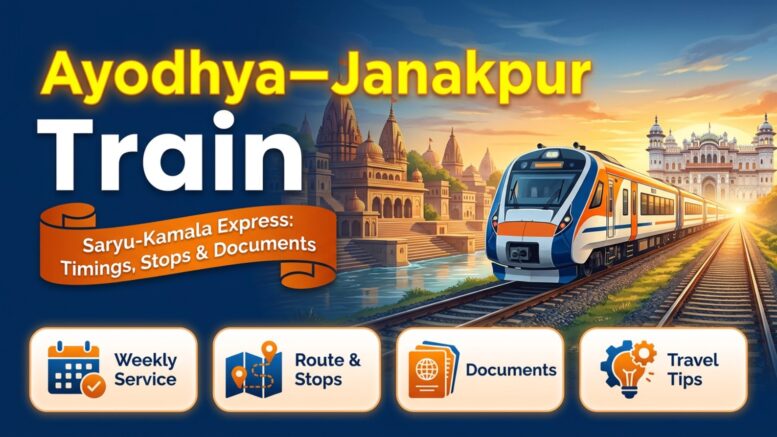
You can now board a direct train from Ayodhya to Janakpur Dham in Nepal, linking the birthplaces traditionally associated with Lord Ram and Goddess Sita. Here is what pilgrims and travellers need to know about the new Saryu-Kamala Express before planning a trip.
What has been launched
Prime Minister Narendra Modi and Nepal’s Prime Minister Balendra Shah virtually flagged off the new cross-border passenger service on 23 November 2026. The train, named the Saryu-Kamala Express, connects Ayodhya Cantt in Uttar Pradesh with Janakpur Dham in Nepal’s Madhesh region.
The Ministry of Railways had first announced the weekly service in mid-November. The inaugural special ran on 23 November from Ayodhya Dham, reaching Janakpur Dham the next morning, and the return special arrived back in Ayodhya on 25 November. Regular weekly runs are reported to begin from 28 November.
For travellers, the bigger story is convenience. Until now, a pilgrim wanting to visit both towns usually had to combine trains, buses and road transfers via the Bihar border. A single overnight train removes much of that hassle and is expected to give a boost to the wider Ramayan Circuit.
Route, stops and travel time
The train covers roughly 604 km in about 19 hours, passing through Uttar Pradesh and Bihar before crossing into Nepal. As per the railway ministry, commercial halts include Ayodhya Dham, Mankapur, Basti, Gorakhpur, Narkatiaganj, Raxaul, Sitamarhi, Shisho, Madhubani and Jaynagar. It runs with a modern 17-coach LHB rake, according to media reports.

Gorakhpur, Raxaul and Jaynagar are useful boarding points for travellers from eastern UP and north Bihar, while Madhubani and Sitamarhi are themselves places many pilgrims like to visit. Sitamarhi is linked in tradition with Sita’s appearance, and Madhubani is famous for its folk painting.
Key facts and timings
| Detail | Information |
|---|---|
| Train | Saryu-Kamala Express (Ayodhya Cantt – Janakpur Dham) |
| Flag-off | 23 November 2026 (virtual) |
| Regular service | Reported to start 28 November 2026; once a week each way |
| Ayodhya to Janakpur | Every Monday, departs 5:50 pm; arrives Tuesday 12:40 pm (Nepal time) |
| Janakpur to Ayodhya | Every Saturday, departs 1:10 pm (Nepal time); arrives Sunday 8:10 am |
| Distance / journey time | About 604 km / around 19 hours |
| Inaugural train numbers | 04295 and 04296 (special runs only) |
Note that Nepal Standard Time runs 15 minutes ahead of Indian Standard Time, so read the timetable carefully. Since 28 November falls on a Saturday, the first regular run is likely to start from Janakpur Dham, with the first regular departure from Ayodhya on the following Monday. Fares, coach classes and the permanent train numbers had not been clearly published in the reports we checked, so confirm these on the official Indian Railways enquiry and booking channels before you plan.
Documents you should carry
Indian citizens do not need a visa for Nepal, but identity rules still apply. The Embassy of India in Kathmandu says only a valid Indian passport or an original Election Commission voter ID card with photograph are accepted for air travel between the two countries; Aadhaar, PAN and driving licences are not accepted, and downloaded or printed voter ID copies do not count. A Home Ministry notification issued on 5 November 2026 also requires travellers to carry a recognised identity document.

Rules for land crossings and for children can differ, so the safest approach is to carry your passport or original voter ID, and check the embassy’s current guidance on documents for minors before boarding. The train halts at the Jaynagar customs yard, so expect border checks there.
Practical tips for travellers
- Plan around the weekly schedule: With just one run each way per week, missing the train means a seven-day wait. Build buffer time into your itinerary.
- Book early around festivals: Major religious festivals draw large crowds to both Ayodhya and Janakpur, so seats may fill fast around such dates.
- Carry some Nepali currency: Small expenses such as autos and food in Janakpur are easier with local cash.
- Explore Janakpur: The town is known for the Janaki Mandir and several sacred ponds, and can be covered in a day or two.
- Combine with Ayodhya: Plan a day for the Ram Mandir and the ghats of the Saryu before or after your journey.
- Check mobile roaming: Indian SIMs may not work in Nepal without international roaming, so activate it or buy a local SIM.
Why it matters
Officials and reports describe the link as a boost for religious tourism and people-to-people ties between India and Nepal. Hotels, guides, traders and artisans along the route in UP, Bihar and Madhesh Province are expected to benefit from more visitors. For ordinary travellers in the border belt, it simply adds one more reliable transport option.
Frequently Asked Questions
When does the Ayodhya-Janakpur train run?
The regular service runs once a week in each direction. It leaves Ayodhya Cantt every Monday at 5:50 pm and Janakpur Dham every Saturday at 1:10 pm (Nepal time), with weekly runs reported to start from 28 November 2026.
Do Indians need a passport to travel on this train to Nepal?
A visa is not required, but you should carry a valid Indian passport or an original voter ID card with photograph. Aadhaar, PAN and driving licences are not accepted for air travel, so do not rely on them; check the Indian Embassy in Kathmandu’s guidance for land travel and minors.
What is the fare for the Saryu-Kamala Express?
Fares had not been clearly published in the reports available at the time of writing. Check the official Indian Railways enquiry and booking platforms for the latest fares, classes and seat availability.
Information as of 25 November 2026. Check Press Information Bureau (Ministry of Railways) for the latest updates.
Image credits: “Ram Ki Paidi waterfront” by Vanshiikaa, Wikimedia Commons, CC0