
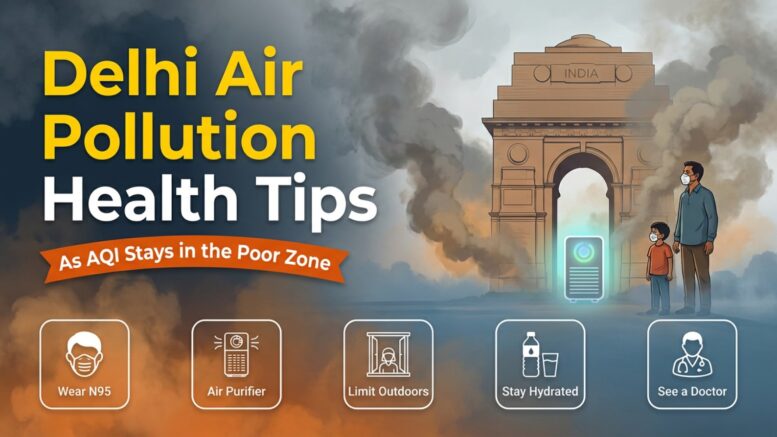
Delhi’s air has stayed in the “poor” category for more than a week, and forecasts suggest no quick relief. Here are simple, practical health tips to protect yourself and your family while the smog lingers.
Where Delhi’s Air Quality Stands Right Now
On the morning of November 25, 2026, Delhi’s Air Quality Index (AQI) was reported at 228, in the “poor” category, based on Central Pollution Control Board (CPCB) data reported by Business Standard and News24. It was 242 at the same time a day earlier. The CPCB daily average for November 24 was 227, which The Patriot reported as the tenth straight “poor” day for the city.

Some areas were worse. Business Standard reported readings above 300 (“very poor”) at stations including Anand Vihar, DTU and North Campus on November 25. News outlets reported slightly different numbers for some stations, as readings change hour to hour.
The Air Quality Early Warning System run by IMD and IITM has forecast “poor” air until about November 27, followed by “poor to very poor” conditions over the following days. November 25 was also the coldest morning of the season so far, with a minimum of around 12°C and morning mist, according to reports.
What Restrictions Are in Force?
The Commission for Air Quality Management (CAQM) revoked Stage III of the Graded Response Action Plan (GRAP) on November 17, 2026, as air quality improved, according to a PIB release. Stages I and II continue to apply across Delhi-NCR. These include measures such as dust control at construction sites and curbs on open burning.

Understanding the AQI Scale
The national AQI scale used by CPCB, along with general advice from the Health Ministry’s advisory on air pollution, is summarised below:
| Category | AQI Range | General Advice |
|---|---|---|
| Good | 0–50 | No special precautions |
| Satisfactory | 51–100 | Sensitive people may reduce long, strenuous outdoor activity |
| Moderate | 101–200 | Reduce long or heavy outdoor exertion; sensitive groups should avoid it |
| Poor | 201–300 | Avoid outdoor physical exertion |
| Very Poor | 301–400 | Avoid outdoor activity, especially early morning and late evening; vulnerable people should stay indoors |
| Severe | 401–500 | Avoid outdoor activity; vulnerable people should stay indoors and keep activity light |
Practical Health Tips for Poor Air Days
The Health Ministry’s National Centre for Disease Control (NCDC) advisory on air pollution and health offers several simple steps. Here they are in everyday terms:

- Shift your workout indoors: On poor to severe days, skip early morning and late-evening walks or runs outdoors, when pollution often peaks. Try indoor exercise or yoga instead.
- Time your ventilation: Keep windows closed in the early morning and late evening. If you need fresh air, open them for a while between about 12 noon and 4 pm.
- Wear the right mask: A well-fitted N95 or N99 mask can help when you go out. Cloth masks, surgical masks and scarves offer little protection against fine particles.
- Avoid smoke indoors: Do not smoke, and avoid burning incense sticks, mosquito coils, wood or waste inside closed rooms.
- Clean smartly: Wet-mop floors instead of sweeping, which can stir dust back into the air.
- Stay away from hotspots: Where possible, avoid walking along busy roads and near construction sites.
- Eat and drink well: Drink enough water and include fresh fruits and vegetables in your meals as part of a balanced diet.
- Simple relief: Rinsing your eyes with clean running water and gargling with warm water can ease irritation.
- In the car: Keep windows up and set the AC to recirculation mode in heavy traffic.
Who Needs Extra Care?
The advisory identifies some groups as more vulnerable to polluted air: children under five, older adults, pregnant women, people with heart or lung conditions such as asthma or COPD, and people who work outdoors. If someone in your home falls into these groups, plan their outdoor time carefully and keep any prescribed medicines handy.
When to see a doctor: Seek medical advice promptly if you or a family member has breathlessness, chest pain, dizziness, a persistent cough, or red, watery eyes. People with existing conditions should consult their doctor about how to manage symptoms during high-pollution periods. This article is general wellness information and not medical advice.
Frequently Asked Questions
What does an AQI of 228 mean for my health?
An AQI between 201 and 300 is “poor”. Prolonged exposure can cause breathing discomfort even in healthy people, so it is best to avoid heavy outdoor exercise.
Is it safe to go for a morning walk in Delhi now?
The Health Ministry’s advisory suggests avoiding early morning and late-evening outdoor exercise on poor to severe air days. Consider indoor exercise until air quality improves.
How can I check the AQI in my area?
You can check live readings on CPCB’s SAMEER app or the official AQI websites. Readings vary by locality, so check the station nearest you.
Information as of November 25, 2026. Check the NCDC advisory on air pollution and health and CPCB’s SAMEER app for the latest updates.