
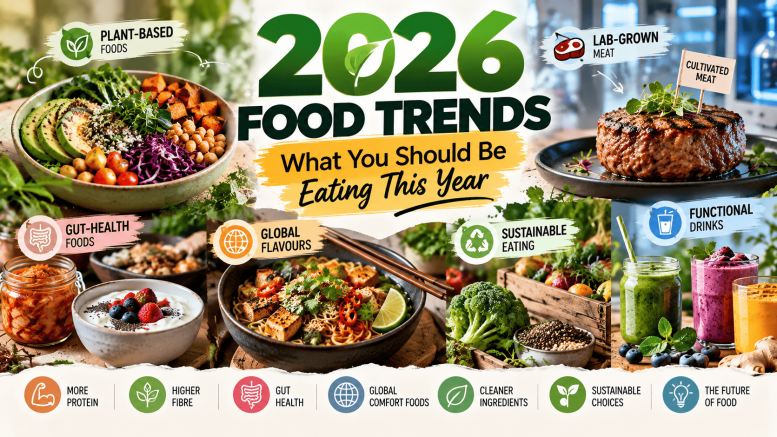
Food trends used to be about the next viral ingredient or Instagram-worthy dish. In 2026, the picture looks different.
People still want food that tastes good, but health, convenience, affordability, ingredient transparency and sustainability are increasingly influencing what ends up on the plate. Protein remains hugely popular, while fibre and gut health are catching up quickly. Restaurants are also leaning into global comfort food, local ingredients and familiar dishes with unexpected flavours.
Here are the biggest food trends 2026 is bringing to kitchens, supermarkets and restaurant menus.
1. Fibre Is Finally Getting Its Moment
Protein has dominated food marketing for years. In 2026, fibre is becoming much harder to ignore.
Whole Foods Market identified fibre as one of its major 2026 trends, pointing to more breads, pastas, crackers, drinks and snacks being marketed around fibre and prebiotics. Penn State Extension similarly notes growing consumer interest in both protein and fibre.
But you don’t necessarily need a new packaged “high-fibre” product.
Many everyday foods are naturally good sources:
- Beans and lentils
- Chickpeas
- Oats
- Whole grains
- Fruits and vegetables
- Nuts and seeds
Beans are particularly interesting because they combine plant protein and fibre in one inexpensive ingredient.
Try it in 2026: Add chickpeas to salads, lentils to soups, oats to breakfast and beans to wraps or rice bowls.
2. Protein Is Staying, But the Conversation Is Changing
High-protein eating isn’t disappearing.
In fact, protein remains one of the dominant nutrition trends of 2026. What’s changing is where people expect to find it.
Protein is moving beyond shakes and gym supplements into everyday foods, including breakfast products, snacks, bowls and restaurant add-ons. The National Restaurant Association lists protein add-ons among its top overall restaurant trends for 2026.
Consumers are also looking beyond a single protein source.
Eggs, yoghurt, fish and lean meats sit alongside beans, lentils, tofu, tempeh, nuts and other plant-forward options.
The more practical 2026 approach isn’t necessarily “maximum protein.” It’s building satisfying meals that combine protein with fibre and other nutrients.
3. Gut-Friendly Foods Move Into the Mainstream
Gut health is no longer a niche wellness conversation.
Fermented foods such as yoghurt, kefir, kimchi, sauerkraut, miso and certain fermented drinks are receiving more attention, alongside prebiotic ingredients and fibre-rich foods that support the gut microbiome.
The trend is particularly visible in India. Innova Market Insights identifies gut health, protein-rich foods and functional beverages among the key themes shaping India’s food and beverage market in 2026.
Fermented ingredients also have another advantage: flavour.
Miso can bring umami to marinades. Kimchi can transform a simple rice bowl. Yoghurt works in breakfast, dips and sauces.
That means gut-conscious eating doesn’t have to feel like a health programme.
4. Plant-Forward Eating Becomes More Practical
The plant-based conversation is becoming less binary.
Instead of asking everyone to choose between being vegan and eating meat, future food trends increasingly point towards plant-forward eating: putting more vegetables, beans, legumes, grains, mushrooms, nuts and seeds on the plate without necessarily eliminating animal products altogether.
This makes the approach easier to adopt.
A meat eater can still make lentil curry, order a mushroom-based dish or swap one weekly meat meal for beans or tofu.
The emphasis is increasingly on variety rather than labels.
5. Global Comfort Food Is Having a Big Year
One of the tastiest trends of 2026 combines two things people rarely get tired of: comfort and discovery.
The National Restaurant Association’s culinary forecast highlights global comfort foods, elevated instant noodles, Caribbean curry bowls and miso-glazed proteins among important menu directions.
Think:
Ramen with restaurant-level toppings.
Caribbean curries served as convenient bowls.
Miso-glazed fish, meat or tofu.
Classic burgers reworked with flavours from different cuisines.
People want something familiar enough to feel comforting but interesting enough to make eating out worthwhile.
For home cooks, this is one of the easiest trends to try. A new spice blend, fermented condiment or regional sauce can completely change an everyday meal.
6. Cleaner, Simpler Ingredient Lists Matter More
Consumers are paying more attention to what’s actually inside their food.
Penn State’s 2026 trend analysis notes growing consumer association between “healthy” foods and minimal processing or fewer artificial ingredients and preservatives. Restaurants are responding too, with cleaner recipes and less-processed menu items appearing among the National Restaurant Association’s major trends.
That doesn’t mean every processed food is automatically unhealthy.
Instead, it reflects a broader desire for food people can understand.
For shoppers, a sensible approach is to look at the whole nutritional picture rather than being persuaded by a single “natural”, “clean” or “high-protein” claim on the front of a package.
7. Functional Drinks Keep Expanding
The beverage aisle increasingly looks like an extension of the wellness aisle.
Consumers are seeing drinks marketed around:
- Prebiotics
- Gut health
- Hydration
- Protein
- Energy
- Relaxation
- Reduced sugar
India is seeing similar momentum, with functional beverages identified as a notable 2026 consumer trend.
But functional claims deserve some healthy scepticism.
A drink doesn’t automatically become nutritious because it contains one fashionable ingredient. Sugar, caffeine, serving size and the rest of the ingredient list still matter.
8. Local and Seasonal Food Gets New Attention
Sustainability is showing up in food choices in a much more practical way.
Local sourcing ranks at the top of the National Restaurant Association’s overall 2026 trends, reflecting interest in fresher ingredients, community connections and more transparent sourcing.
For consumers, sustainable eating doesn’t need to mean buying expensive speciality products.
It can be as straightforward as:
- Choosing seasonal produce
- Buying locally grown ingredients when practical
- Planning meals before shopping
- Using leftovers creatively
- Freezing food before it spoils
- Choosing reusable containers
- Eating more plant-forward meals
Sometimes the most sustainable ingredient is simply the one you already have in your fridge.
9. Food Waste Becomes Part of Home Cooking
Sustainable cooking is moving beyond what we buy to how much we throw away.
Vegetable stems can go into stocks. Overripe bananas can become breakfast or baking ingredients. Leftover rice can become fried rice. Yesterday’s roasted vegetables can go into wraps, soups or grain bowls.
Restaurants are also increasingly thinking about sustainability through sourcing and packaging, with compostable and reusable packaging included among notable 2026 industry trends.
This trend has an unusually attractive benefit: reducing food waste can also reduce grocery spending.
10. Cultivated Meat Is Progressing, But Don’t Expect It Everywhere Yet
Lab-grown or, more accurately, cultivated meat continues to generate headlines.
The technology grows animal cells in controlled environments to produce food without raising an entire animal.
But there’s an important difference between technological progress and widespread availability.
As of the FDA’s February 2026 inventory, five cultured-animal-cell foods had completed its pre-market consultation process, including cultured chicken, pork fat and salmon materials from different companies.
That makes cultivated meat a genuine developing food category, but it doesn’t mean conventional meat is about to disappear from supermarket shelves.
Cost, production scale, regulation, consumer acceptance and taste will all influence how quickly the category grows.
For now, cultivated meat is better viewed as a technology to watch than something most households will regularly eat in 2026.
11. Value Is Becoming a Food Trend Too
Not every trend is about a new ingredient.
Affordability itself is shaping what people eat.
The National Restaurant Association identifies value as one of 2026’s major restaurant trends, alongside comfort food and local sourcing.
That’s helping familiar, adaptable foods thrive.
Noodles, rice bowls, beans, soups, burgers and other everyday dishes can deliver comfort without requiring expensive ingredients.
This may also explain why “elevated” versions of simple foods are resonating. Consumers still want novelty, but they don’t necessarily want luxury pricing every time they eat.
12. Nostalgia Gets a Global Upgrade
The foods people grew up eating aren’t going anywhere.
Instead, chefs and brands are remixing them.
The 2026 restaurant forecast points towards nostalgia combined with global flavours, creating familiar dishes with new sauces, spices, textures and cultural influences.
A burger can borrow flavours from another cuisine. Instant noodles can become a restaurant dish. Traditional desserts can be reworked with unexpected ingredients.
It’s comfort food without being predictable.
So, What Should You Actually Eat in 2026?
You don’t need to chase every viral ingredient.
If there’s one useful lesson from the year’s trending foods, it’s that many of the strongest trends point back towards surprisingly ordinary ingredients.
Eat a wider variety of plants. Get fibre from whole foods. Include appropriate protein sources. Experiment with fermented foods if you enjoy them. Explore cuisines beyond your usual choices. Waste less food. And pay attention to the overall quality of a product rather than a single marketing claim.
That approach is considerably more practical than rebuilding your diet every time TikTok discovers a new “superfood.”
What to Watch Next in Food
The second half of 2026 is likely to keep pushing food in two directions at once.
On one side, technology is moving forward through cultivated meat, new food-production systems and increasingly functional products.
On the other, consumers and restaurants are rediscovering very traditional ideas: local ingredients, fermentation, fibre-rich staples, comfort food and simpler recipes.
That contrast may define the most interesting food trends 2026 has produced.
The future of eating isn’t necessarily about replacing familiar food with futuristic alternatives. It may be about combining new technology and nutrition knowledge with the foods and cooking habits that have worked for generations.
